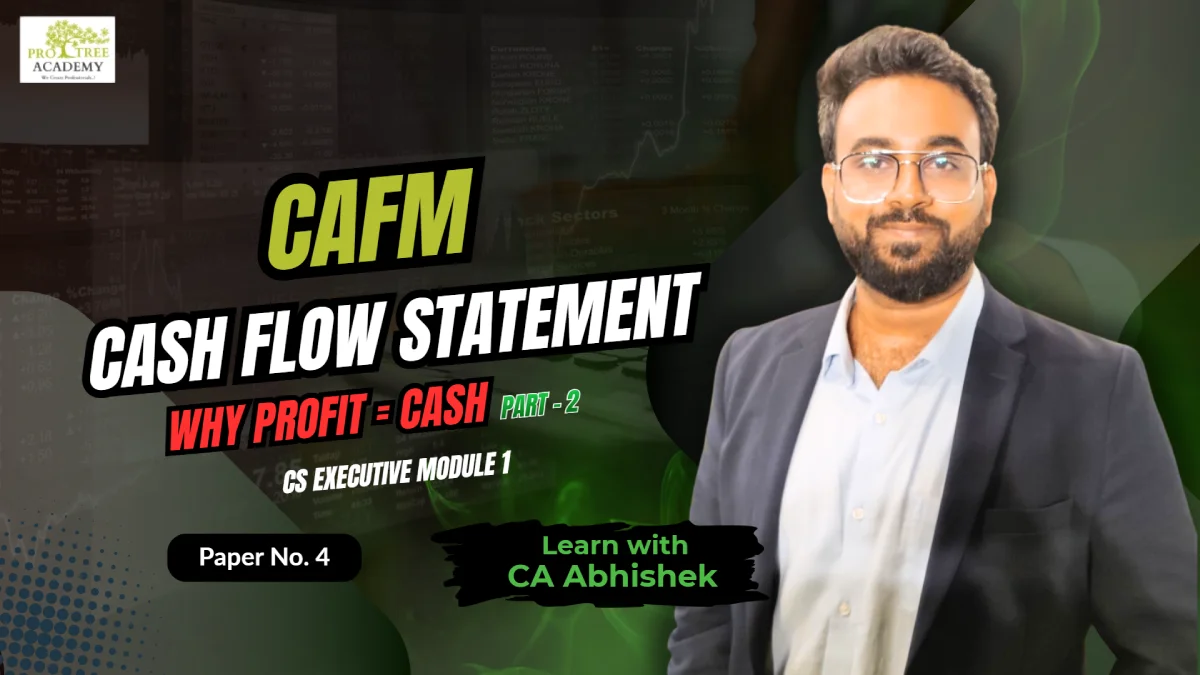
Cash Flow Statement Explained (Lecture 1): Why Profit ≠ Cash
View More Lectures

Basics of Capital Market & Securities Laws
Understanding the Indian financial system begins with a clear grasp of its two primary pillars: the Capital Market & Securities Laws. Whether you are a student, a CS aspirant, or an individual investor, knowing where to put your funds and for how long is the key to financial success.
Why Profit is Not Always Cash: Understanding the Cash Flow Statement
Have you ever looked at a company’s Profit and Loss (P&L) statement, seen a profit of ₹1,000, and assumed that money was sitting in the bank? If so, you’re missing a crucial piece of the financial puzzle. In reality, profit is an opinion, but cash is a fact.
The “Ulta” Logic of Cash Flow
Most financial statements are prepared on an accrual basis. This means income and expenses are recorded the moment they occur, regardless of when the actual money changes hands. If you sell goods on credit, your P&L shows a profit, but your bank account remains unchanged.
The Cash Flow Statement (CFS) is the “ulta” (opposite) of this. It only cares about actual movement—money coming in (inflow) and money going out (outflow). It tells you the truth about a company’s liquidity position: its ability to convert assets into cash to pay bills and survive.
The Three Pillars of Movement
To provide a clear picture, the Cash Flow Statement categorizes every transaction into three broader activities:
- Operating Activities: These are your day-to-day business operations—sales, purchases, salaries, and rent. For a manufacturer, selling a car is operating; for a bank, lending money and receiving interest is operating.
- Investing Activities: This involves putting money into long-term growth, like purchasing fixed assets (land, machinery) or investing excess funds in mutual funds and FDs.
- Financing Activities: This covers how you raise or repay capital. Issuing shares, taking loans, or paying out dividends all fall under this umbrella.
Why It Matters: A Cautionary Tale
Liquidity planning can make or break a business. Consider a company that grew its turnover from ₹35 crores to ₹250 crores but got stuck there because all its money was tied up in receivables. Without cash planning, you cannot pay vendors or salaries, effectively killing expansion.
By analyzing the CFS, management can decide whether to issue fresh shares for expansion or invest surplus cash into income-generating assets. Ultimately, the Cash Flow Statement ensures that while you’re chasing profits, you don’t run out of the cash needed to keep the lights on.
Chief Faculty

CA Abhishek H
Lecture
Learn from experienced faculty at ProTree Academy and strengthen your preparation with structured guidance. www.protreeacademy.com
Gain Your Competitive Edge for Success
Understanding Company Law in Real Business Situations: A Practical Guide for CS Aspirants
Company law acts as the legal framework that regulates how companies are formed, managed, and dissolved. In India, the Companies Act, 2013 serves as the primary legislation guiding corporate operations.
⭐ What makes ProTree Academy Stand Out?
✔ Corporate-Reality Based Teaching
Students learn exactly how companies operate legally and strategically.
✔ Structured Study Roadmap
Every student follows a step-by-step process—from classes to revision to final strategy.
✔ Mindset, Discipline & Confidence Building
We train students not only to pass exams but to think like corporate professionals.
✔ Consistent Mentorship
From academics to stress management — ProTree supports you throughout your journey.
Get In Touch
We would love to hear from you! Please feel free to get in touch with us for any queries or information regarding our courses. Our team is always ready to assist you.
Gain Your Competitive Edge for Success

ProTree Academy offers expert-led coaching for CA and CS aspirants with a structured curriculum, personalized guidance, and exam-focused learning. Build a strong foundation, excel with confidence, and unlock your professional future.
Start your CA/CS journey with ProTree Academy today — Enroll Now!
Copyright ©2026 | All rights and content reserved by ALTA Insula Corporate.